
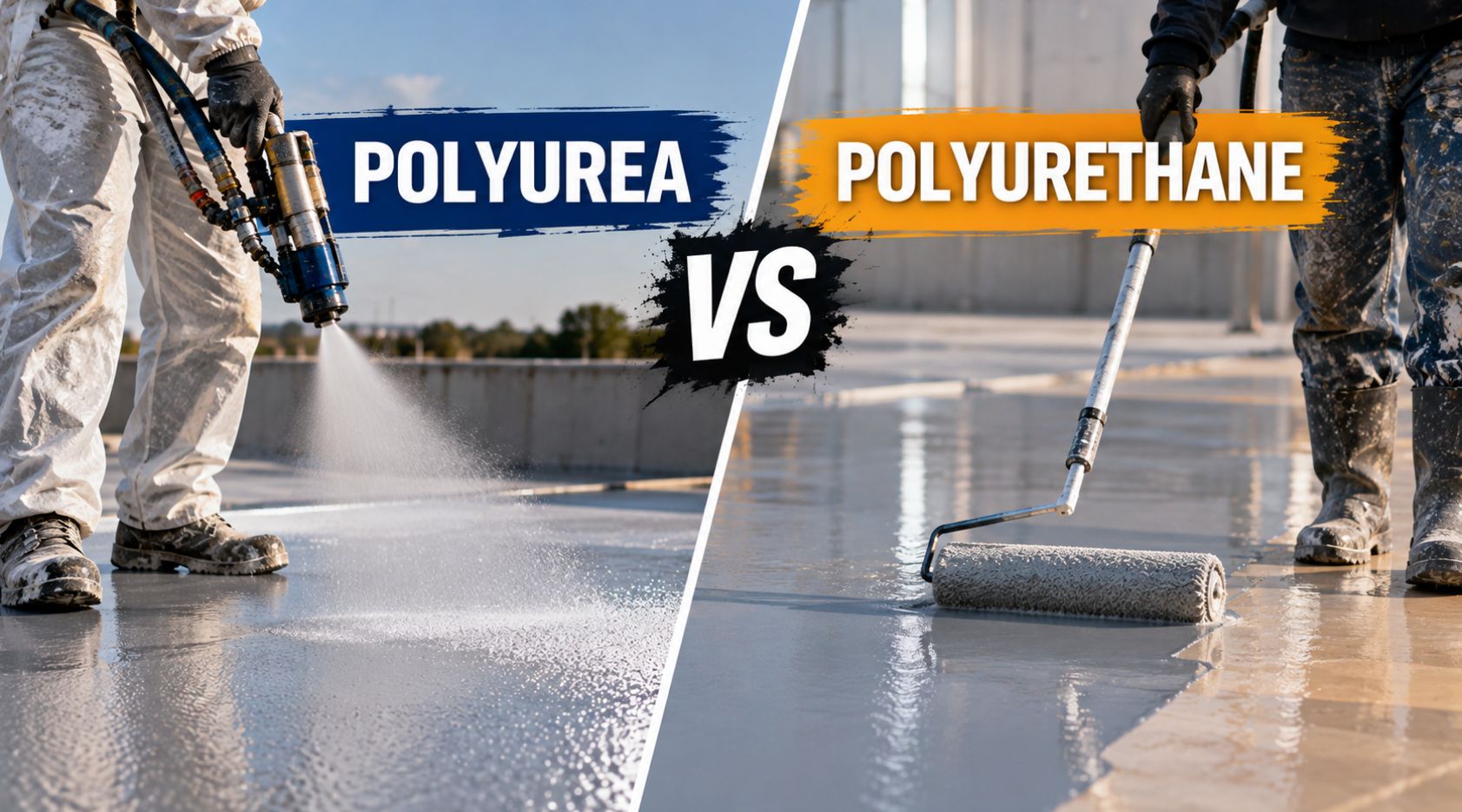
Polyurea vs Polyurethane Coatings: Key Differences Explained
Walk onto a job site and ask five people to explain the difference between polyurea and polyurethane coatings, and you’ll probably get five slightly different answers, some of them wrong. It’s an easy mix-up. Both come from isocyanate chemistry, both show up ... Read morePolyurea vs Polyurethane Coatings: Key Differences Explained
The short versionKey takeaways
- 01Polyurethane forms when that isocyanate reacts with a polyol, a compound built around hydroxyl groups.
- 02Polyurethane needs drier, more controlled conditions to cure properly, or moisture can interfere and cause bubbling, pinholing, or a weaker film.
- 03It’s also common in situations where the slower cure isn’t a problem and the application crew is working with more standard equipment.
- 04Don’t assume “polyurea” and “polyurethane” are interchangeable marketing terms.
- 05Polyurea systems generally cost more per unit than standard polyurethane, driven by both the raw material cost of the amine resin and the specialized equipment needed to apply it correctly.
- 06Polyurethane topcoats, when properly maintained, tend to need less frequent attention specifically for UV-related fading and chalking, since that’s the property they’re often chosen for in the first place.
Walk onto a job site and ask five people to explain the difference between polyurea and polyurethane coatings, and you’ll probably get five slightly different answers, some of them wrong. It’s an easy mix-up. Both come from isocyanate chemistry, both show up as protective coatings on floors, roofs, and industrial surfaces, and both get marketed under language that sometimes blurs the line between them on purpose. But they cure differently, handle moisture differently, and end up with real performance differences that matter once you’re choosing one for an actual project rather than just reading a spec sheet.
Same Starting Point, Different Reaction#
Both polyurea and polyurethane start with an isocyanate component. That part’s identical. What happens next is where they split.
Polyurethane forms when that isocyanate reacts with a polyol, a compound built around hydroxyl groups. This reaction is comparatively gentle. It usually needs a catalyst to move along at a workable pace, and it’s sensitive to moisture in the air and in whatever substrate it’s being applied to, since water competes with the polyol for the isocyanate’s attention.
Polyurea, at least in its pure form, skips the polyol entirely and reacts the isocyanate with an amine-terminated resin instead. Amines are far more aggressive reaction partners than polyols, which is exactly why this reaction doesn’t need a catalyst and barely slows down for a little ambient moisture. The practical result: polyurea gels in seconds, sometimes less, while polyurethane takes anywhere from several minutes to a few hours depending on the formulation.
What That Chemistry Difference Actually Changes#
Cure speed. This is the headline difference, and it’s not a small one. A pure polyurea system can be walkable within a couple hours of spraying. A polyurethane system might need a full day or longer before it’s ready for traffic, sometimes more depending on ambient conditions and film thickness.
Moisture tolerance. Polyurea’s fast amine reaction wins the race against ambient moisture almost every time, which is why it’s the go-to choice for damp climates, cold-weather applications, and jobs where the substrate can’t be guaranteed bone dry. Polyurethane needs drier, more controlled conditions to cure properly, or moisture can interfere and cause bubbling, pinholing, or a weaker film.
Flexibility. Polyurea generally holds onto its elongation and flexibility across a wider temperature range. Polyurethane can perform very well too, but tends to stiffen up faster in cold conditions unless the specific formulation was built to resist that.
UV stability. Here’s where polyurethane usually wins. Aliphatic polyurethane topcoats hold color and gloss under sunlight noticeably better than most polyurea formulations, which is exactly why you’ll often see a polyurethane topcoat layered over a polyurea base coat rather than either one used alone on a UV-exposed surface.
Application equipment. Polyurea’s speed is unforgiving on the equipment side. It needs proportioning gear built to handle that fast reaction accurately, or the ratio drifts and the finished coating underperforms. Polyurethane’s slower reaction gives application equipment more margin for error, which is one reason it remains a more accessible entry point for contractors newer to plural-component spray systems.
Side-by-Side Comparison#
| Factor | Polyurethane | Pure Polyurea |
|---|---|---|
| Reaction partner | Polyol | Amine |
| Catalyst needed | Usually | No |
| Cure time | Minutes to hours | Seconds |
| Moisture sensitivity | Higher | Low |
| UV stability | Strong | Weaker without a topcoat |
| Cold weather flexibility | Formulation-dependent | Generally strong |
| Application forgiveness | More tolerant of equipment variance | Less tolerant, requires precise ratio control |
Where Each One Tends to Get Used#
Polyurethane shows up most often as a topcoat, a clear or pigmented finish layer applied over a base coat, whether that base is polyurea, epoxy, or concrete itself, specifically for the UV stability and gloss retention it brings. It’s also common in situations where the slower cure isn’t a problem and the application crew is working with more standard equipment.
Polyurea earns its place on jobs where speed, moisture tolerance, or flexibility carry real weight. Secondary containment, tank linings, industrial floors that can’t stay down long, and any project happening in less-than-ideal weather conditions tend to favor polyurea’s chemistry advantages. It’s also common as a spray-applied base coat under a polyurethane topcoat, which lets a system capture the strengths of both: polyurea’s speed and flexibility underneath, polyurethane’s UV resistance on top.
For a closer look at how that speed advantage plays out in actual field application, our guide on polyurea spray application techniques and best practices covers the equipment and process side of working with fast-reacting polyurea systems, including the inspection steps that confirm a job was done to spec.
Things to Consider Before Choosing#
Don’t assume “polyurea” and “polyurethane” are interchangeable marketing terms. They’re chemically distinct, and using the wrong one, or a hybrid blend when a pure system was actually needed, can lead to a coating that underperforms for the specific exposure it’s facing.
Match the chemistry to your actual weather and schedule constraints. A project with a tight closure window or unpredictable weather leans toward polyurea’s speed and moisture tolerance. A project with a controlled indoor environment and no rush has more flexibility to use either.
Ask whether a topcoat is part of the system. If the finished surface will see direct, long-term UV exposure, confirm whether a UV-stable topcoat is included, since an uncoated polyurea base can chalk and fade over time without one.
Check the equipment being used, especially for polyurea. Ask the contractor about their proportioning equipment and how they handle ratio control, since polyurea’s fast reaction leaves very little room to correct a mixing error once material starts flowing.
Get the technical data sheet for the actual product, not the general category. Performance numbers, recommended film thickness, and application temperature range vary by manufacturer and specific formulation, even within either broad chemistry category.
Cost and Project Planning#
Polyurea systems generally cost more per unit than standard polyurethane, driven by both the raw material cost of the amine resin and the specialized equipment needed to apply it correctly. That higher cost often gets justified on projects where downtime has a real dollar value attached, since polyurea’s faster return-to-service can offset the material premium once lost production time or facility closure costs are factored in. Polyurethane holds a cost advantage on projects without that time pressure, where a longer cure window isn’t actually a problem.
Maintenance Differences#
Polyurethane topcoats, when properly maintained, tend to need less frequent attention specifically for UV-related fading and chalking, since that’s the property they’re often chosen for in the first place. An uncoated polyurea surface exposed to direct sun will eventually chalk regardless of how well it was applied, which is a maintenance and appearance issue rather than a structural one, but worth planning for with a recoat schedule if long-term appearance matters. Both chemistries hold up well against abrasion and general wear when properly applied over a well-prepared substrate, and routine inspection for seam integrity, impact damage, and any signs of substrate movement remains good practice regardless of which system was used.
Frequently Asked Questions#
Is polyurea just a faster version of polyurethane?
Not exactly. They’re built on different chemical reactions, amine versus polyol, and that difference drives more than just cure speed. Moisture tolerance, flexibility, and UV stability all differ between the two as a result.
Can polyurea and polyurethane be used together on the same project?
Yes, and it’s a common approach. A polyurea base coat paired with a polyurethane topcoat combines fast cure and flexibility with strong UV resistance, playing to each chemistry’s strengths.
Which one is better for outdoor applications?
It depends on what “better” means for the project. Polyurea handles moisture and temperature swings well during application. Polyurethane holds color and gloss better under long-term UV exposure. A lot of outdoor systems use both together for exactly this reason.
Why does polyurea need special spray equipment?
Because its reaction happens in seconds, the proportioning equipment has to maintain precise ratio control continuously. Even a small drift in ratio can affect cure quality in a system that doesn’t have the working time to self-correct the way a slower-curing polyurethane does.
Does one of these cost significantly more than the other?
Polyurea generally costs more per unit due to material and equipment demands, though the total project cost comparison should include factors like downtime and return-to-service time, not just material price alone.
Conclusion#
Polyurea and polyurethane both trace back to isocyanate chemistry, but the reaction each one runs, amine versus polyol, produces genuinely different materials with different strengths. Polyurea wins on speed, moisture tolerance, and flexibility. Polyurethane wins on UV stability and forgiving application. Plenty of the best-performing coating systems use both together rather than treating the choice as either-or. Understanding which properties actually matter for a specific project, rather than defaulting to whichever name sounds more familiar, is what separates a coating system that performs from one that was picked based on marketing language alone.
Was this article useful?
Thanks — that helps us decide what to write next.
Have a coating problem worth researching?
Radiant Polymers publishes independent analysis of polymer coating chemistry, field performance and specification practice. Send us the question.
Background reading
- Understanding Elastomers: Properties, Types, and Uses
- A Glossary of Polymer Chemistry and Coating Technology Terms
- How Polymer Coatings Work: The Science Behind Surface Protection
- Polymer Coating Failure: Causes, Prevention, and Analysis
- Industrial Coating Applications: From Infrastructure to Defense
- Polyurea Spray Application: Techniques and Best Practices